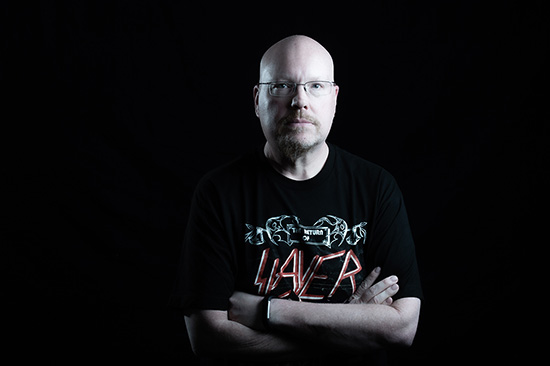
The Fan Who Built a Fortress: A Birthday Tribute to Brian Slagel and the Legacy of Metal Blade
From tape-trading in his bedroom to architecting the global metal scene, Brian Slagel’s journey is a testament to the power of musical obsession. On his birthday, we dive deep into the life of the man who gave heavy metal a home.
It is difficult, perhaps impossible, to imagine the landscape of modern heavy metal without Brian Slagel.
Today, as we celebrate his birthday, we aren't just honoring a successful CEO or a savvy record executive. We are honoring a cornerstone. In an industry notorious for chewing up its idealists and spitting out cynicism, Slagel has remained miraculously, wonderfully unchanged at his core: he is still the ultimate fan.
For over four decades, Metal Blade Records has been more than a label; it has been a seal of authenticity, a lighthouse for those drawn to the aggressive, the intricate, and the heavy. But before the global distribution deals, the platinum records, and the legendary roster ranging from Slayer to Amon Amarth, there was just a kid in suburban California with an insatiable hunger for noise.
The story of Brian Slagel is the ultimate heavy metal fairytale—a story of how pure, unadulterated passion manifested into a global empire.
The California Kid with the Import Hunger
Brian Slagel grew up in the unremarkable sprawl of the San Fernando Valley in the 1970s. It was an era dominated by AM radio soft rock and the tail end of the hippie dream, but young Brian was tuned to a different frequency.
Like many who find their tribe in heavy music, his gateway wasn't subtle. It was the bombast of KISS, the theatrical darkness of Alice Cooper, and the crunch of Deep Purple. Music wasn't just background noise for Slagel; it was an immersive experience. He didn't just buy albums; he studied them. He devoured liner notes, memorized producer credits, and began to understand the architecture of the record industry long before he was part of it.
By his late teens, the domestic offerings weren't heavy enough to sate his appetite. The mainstream American rock scene was bloating into corporate arena rock, losing its edge. Slagel, instinctively, began looking eastward across the Atlantic.
He became a fixture at local record shops, particularly the legendary Oz Records in Woodland Hills. He was the kid waiting for the shipments to arrive, pestering the clerks about anything new and hard. He discovered that something was brewing in the UK—a raw, faster, tougher sound that spoke to him more directly than anything on US radio. He had discovered the New Wave of British Heavy Metal (NWOBHM).
The Tape-Trading Nexus
In the pre-internet era, being a metal fan required intense dedication. There were no Spotify playlists, no YouTube algorithms. There was only the postal service and the sacred underground network of tape trading.
Slagel became a central node in this network. He began corresponding with like-minded fanatics in Europe, trading cassettes filled with hiss and fury. He was receiving bootlegs of Iron Maiden, Saxon, Diamond Head, and Angel Witch long before they had proper US distribution. His bedroom became a library of obscure heavy metal, a treasure trove of sounds that most Americans didn't know existed.
To synthesize this growing knowledge, Slagel started a fanzine, The New Heavy Metal Revue. It was a labor of love, typed out and xeroxed, serving as a beacon for the scattered metalheads of Southern California. It was his way of shouting from the rooftops about the music that was consuming his life.
He eventually landed a job at Oz Records, the very store he haunted. He was no longer just buying the imports; he was the guy curating the "Heavy Metal" section, acting as a tastemaker for the local scene. He was the conduit. If you wanted to know what was happening in London, you asked Brian.
The Meeting That Changed Everything
The lore of heavy metal is filled with fateful encounters, but few are as significant as the day a teenage Danish tennis prodigy walked into the metal section of Oz Records.
Lars Ulrich had recently moved to Newport Beach with his family. Like Slagel, Ulrich was obsessed with the NWOBHM, particularly a band called Diamond Head. Ulrich, feeling isolated in a California scene that favored light rock, was desperately looking for someone who understood his musical language.
He found Brian Slagel.
The two bonded instantly over their shared obsession. They were perhaps the only two people within a hundred-mile radius who knew who Sweet Savage or Tygers of Pan Tang were. They spent hours dissecting riffs, debating drummers, and dreaming of a heavier world.
It was a friendship forged in the fires of fandom. Ulrich was intensely driven, talking about starting a band before he could fully play the drums. Slagel was the walking encyclopedia, the connector. Neither knew it yet, but their synergy was about to strike a match that would burn down the music establishment.
The Garage Days: The Birth of a Blade
By 1982, the Los Angeles music scene was dominated by the burgeoning Sunset Strip glam metal movement—lots of hairspray, spandex, and songs about partying. Slagel hated it. He knew there were heavier, grittier local bands that were being ignored by the clubs and labels.
Drawing inspiration from the DIY ethics of the punk scene and the compilation albums coming out of the UK, Slagel decided to take action. He would curate a compilation album featuring the best unsigned heavy bands in Southern California. He called it Metal Massacre.
The process was laughably primitive by today's standards. Operating out of his mother's garage in Woodland Hills, Slagel borrowed money to press the records. He served as A&R, marketing director, distributor, and shipping clerk.
He needed bands to fill the slots. He tapped local acts like Ratt (before they went full glam), Bitch, and Malice. And, of course, he offered a slot to his friend Lars Ulrich, who had finally put together that band he kept talking about.
They were called Metallica.
When the first pressing of Metal Massacre arrived, Metallica was listed as "Mettallica"—a typo for the ages. But the music on that vinyl was revolutionary. It included their first recording of "Hit the Lights."
Slagel’s influence wasn't limited to vinyl. Around this time, he attended a show at the Woodstock concert venue in Orange County and witnessed a support act that terrified and mesmerized the crowd. They were faster, darker, and more evil than anything he’d seen. They were called Slayer. Slagel signed them almost immediately.
Metal Blade Records was no longer a theoretical concept. In the span of about a year, Brian Slagel had helped launch the careers of two of the "Big Four" of Thrash Metal. He had given a platform to a sound that the mainstream actively despised.
The Steady Hand Through Decades of Noise
The 1980s were a whirlwind. Metal Blade became synonymous with the exploding thrash scene, releasing seminal albums like Slayer’s Show No Mercy and Hell Awaits. Slagel’s ear was impeccable; he had a knack for finding bands that possessed a unique fire, regardless of subgenre.
But the true test of Slagel’s character—and Metal Blade’s resilience—came in the 1990s. As grunge overtook the airwaves, heavy metal became a dirty word in the industry. Major labels dropped metal acts en masse, declaring the genre dead.
Brian Slagel didn't flinch. While others pivoted to chase trends, Slagel doubled down on the heavy. Metal Blade became a fortress for extreme music during those lean years. He championed death metal, giving a home to giants like Cannibal Corpse, proving that there was still a massive, underserved audience hungry for brutality. He kept the lights on for metal when the rest of the world tried to turn them off.
He maintained Metal Blade as an independent entity, fiercely protecting its artistic integrity. He turned down lucrative buyouts from majors, knowing that corporate overlords would never understand the culture the way he did.
The Architect’s Legacy
Today, on his birthday, Metal Blade stands as one of the longest-running and most respected independent labels in music history. The roster is a sprawling testament to Slagel's vision, bridging the gap between classic acts like Fates Warning and King Diamond to modern titans like Amon Amarth and The Black Dahlia Murder.
But Slagel’s legacy isn't just about units sold. It's about cultural impact. He proved that you could build a sustainable business without compromising your tastes. He validated the passions of millions of outcasts, telling them that the music they loved mattered.
If you follow Brian Slagel on social media today, you'll see that very little has changed since the days at Oz Records. He is still excitedly posting about new bands, hockey games, and classic records. He is still incredibly accessible to fans. He still possesses that same wide-wide enthusiasm for a killer riff.
Happy Birthday, Brian. For the music, for the culture, and for the unwavering belief in the power of heavy metal—we are eternally grateful. The scene wouldn't be the same without you.