
Niklas Karlsson & Orbit Culture
Written by The Rockin' Roundtable Editorial
Hero Photo: Stefan Bollmann (CC BY-SA 4.0) • Location: Eksjö, Sweden / North America
"FUCK NO, I'M NOT QUITTING": HOW NIKLAS KARLSSON BUILT METAL'S NEXT GIANT FROM A SWEDISH FARMING VILLAGE
He started with an airbrush-painting mother, a terrible Christmas Behringer guitar, and a midnight social-worker shift. Thirteen years later, Niklas Karlsson and Orbit Culture are tearing across North America alongside Trivium and In Flames—and they’re still running the machine from the small town they refuse to leave.
01 // Askeryd, Airbrushes, and a Terrible Behringer
Heavy metal mythology loves a sprawling, neon-lit metropolis—the Sunset Strip, Birmingham’s iron foundries, or Gothenburg’s rain-slicked harbor. Orbit Culture didn’t come from any of them. Their story begins in Askeryd, a microscopic farming village tucked in rural southern Sweden, fifteen to twenty kilometers outside the wooden garrison town of Eksjö. Gothenburg and Stockholm are both more than a hundred miles away; even Linköping, home of Ghost’s Tobias Forge, is a ninety-minute drive. Out here, there was no "scene" waiting to anoint a young band. There were just fields, winter darkness, and whatever you were stubborn enough to build yourself.
Niklas Karlsson’s parents separated when he was around seven, splitting his childhood into alternating weeks between his mother’s house and his father’s just down the road. Inside his mother’s home, creativity wasn't treated as a frivolous hobby—it was part of the air. A skilled painter and airbrush artist, she spent hours teaching Niklas and his siblings how to draw, shade, and build depth on a blank canvas. Years later, that early visual education would quietly define Orbit Culture’s DNA: the oppressive, dark-on-dark H.R. Giger-inspired eldritch imagery of their album sleeves, their stark monochromatic stage aesthetic, and the obsessive control Niklas exerts over every visual frame the band puts into the world.
The sonic detonation arrived around age seven or eight, when his mother handed him a CD of KISS Greatest Hits. It rewired his brain overnight. For the next several birthdays in a row, another KISS record appeared in his hands. Soon, he was relentlessly campaigning for an electric guitar. One Christmas, she finally relented and bought him a cheap Behringer starter guitar. As Niklas remembers it with a grin, it "sounded like complete shit"—and he loved it more than anything on earth. Though he was a quiet, shy kid on the outside, a very different voice was already growing inside his head: he didn't just want to play guitar. He wanted to stand at the front of the stage.
02 // Eksjö, Drumkit From Hell, and the Gojira LAN Party
At fifteen or sixteen, Niklas finally talked a handful of classmates into forming his first band. They never recorded a single note, yet to a teenager in Askeryd, simply having a band meant everything. So when his mother sold the house in 2010 and moved the family to Eksjö, Niklas reacted with full adolescent apocalypse: "You’re destroying my life now, because I’m in this band!" Eksjö was only a short bus ride away, yet it felt like exile.
His mother was right, of course. Eksjö was just big enough to hide a small pocket of fellow metalheads—and right as his old teenage project dissolved, Niklas got his hands on two pieces of technology that changed his trajectory forever: his first real audio interface and Toontrack’s Drumkit From Hell. Suddenly, he didn't have to wait for a drummer who didn't exist in rural Småland. He could program crushing percussion, track layered guitars, and architect entire songs alone in his bedroom.
Still, his musical vocabulary was missing one crucial piece. At the time, James Hetfield’s bark was heavy enough for him; Lamb of God’s Randy Blythe worked because you could decipher every syllable. Pure, guttural death metal growling still felt foreign—until a late-night LAN party with his friend Maximilian "Max" Zinsmeister. Surrounded by glowing monitors and friends shouting over early-era League of Legends, Niklas slipped on his headphones and pressed play on Gojira’s The Way of All Flesh. When "The Art of Dying" hit, time stopped.
"It was beautiful. It was sad. But it was so fucking powerful, that ending. I was like, 'Guys, I’m going to turn off League of Legends. I have to start to write some music now.'"
That single moment fused the blueprint that still powers Orbit Culture today: the stadium-sized thrash authority of Black Album-era Metallica, the industrial mechanical punch of Static-X, the cinematic sweep of Hans Zimmer film scores, and the devastating emotional gravity of Gojira.
03 // Spelverket, Blowtorched Mannequins, and "Fuck No"
In 2013, at age seventeen, Niklas teamed up with Max Zinsmeister—who had been playing in a hot local Eksjö act called Abstract Noise—alongside drummer Markus Bladh and bassist Christoffer Olsson. They set up shop inside Spelverket, a gritty former power plant station repurposed into a multi-floor artistic hub of rehearsal rooms and makeshift studios. (Later, they would upgrade to a converted barn on the outskirts of Eksjö, a DIY headquarters where they rehearsed, recorded, crashed overnight, and—during one chaotic music video shoot—watched future drummer Christopher Wallerstedt accidentally turn a mannequin into a fireball with a blowtorch.)
Their August 2013 debut EP, Odyssey, sparked immediate local curiosity. Their very first live show in Eksjö took place inside a tiny, cheap-booze dive bar (now derelict and strewn with rubble) where a pale teenage Niklas watched a friend nearly break his neck attempting a stagedive. When their debut full-length In Medias Res arrived in July 2014, the hometown reaction was lukewarm—fans preferred the rawer Odyssey—yet something strange happened online: a pocket of rabid listeners in Germany discovered the record and started hyping them. For four kids in a town nobody could pronounce, the internet suddenly felt like a portal.
Then came the moment that breaks ninety-nine percent of small-town bands. Max stepped away to focus on other projects and a cover band; Christoffer left for university. Walking around Eksjö, a local guy smirked at Niklas and asked, "Yeah, so you’re going to quit now because he’s not with you anymore?"
Niklas didn’t blink. "Fuck no."
If the perceived "talent" had left the room, Niklas decided he would simply forge his own. He locked in and wrote 2016’s Rasen—the album where Orbit Culture’s true voice began to crystallize, introducing soaring, Hetfield-meets-melodeath clean choruses alongside tectonic riffs. Even as they mailed old-school physical demo packages to Nuclear Blast and got radio silence in return, the DIY music video for "Sun of All" quietly climbed past a million YouTube views. And in 2016, the puzzle pieces finally locked into place: driven local shredder Richard Hansson aced his lead guitar audition and immediately pulled in bassist Fredrik Lennartsson. Everyone else from the old Eksjö metal scene had started families or hung up their instruments. The last four hungry guys standing became the steel core of Orbit Culture.

04 // The 24-Hour Social Worker Shift That Changed Everything
By early 2018, Orbit Culture had existed for five years and had still played fewer than ten live shows. To survive, Niklas worked grueling 24-hour shifts as a social worker. It was during one of those overnight shifts, staring at a screen as the clock struck midnight on March 8, 2018, that he hit publish on the self-made music video for "Saw"—the lead salvo from their Redfog EP.
At first, the view counter ticked up slowly. By the next morning, thousands of views were flooding in, followed by tens of thousands, then millions across "Saw," "Redfog," and "See Through Me." Five years of grinding in the dark had finally cracked the vault. Seek & Strike Records came calling. Avocado Booking signed on. In March 2019, when original drummer Markus Bladh stepped down from the escalating workload, Richard’s friend Christopher Wallerstedt slid behind the kit—bringing a ferocious, surgical percussive engine that instantly elevated the band’s ceiling.
On September 20, 2019, Orbit Culture played their first-ever concert outside Sweden at Berlin’s Cassiopeia club, supporting Rivers of Nihil, Black Crown Initiate, and MØL. Less than a year later, in August 2020, they dropped their breakthrough third album, Nija—right into the teeth of the global COVID-19 lockdown. On paper, it should have killed their momentum. In reality, it supercharged it. Millions of metalheads were trapped indoors scrolling YouTube and Spotify, desperate for something massive, modern, and authentic. Nija—followed by 2021’s blistering Shaman EP—became their soundtrack.
05 // Sweden Rock 2022, The Coquihalla Death Slide, and Bus Brotherhood
Because of the pandemic, Orbit Culture arrived at Sweden Rock Festival in June 2022 as an internet juggernaut with barely a dozen gigs under their belts. Five minutes before showtime, Niklas peered out from the wings at a virtually empty field. "This is gonna suck ass," they muttered to each other. Five minutes later, when their intro tape roared to life, over two thousand fans surged to the barricade. For the first time, Niklas saw the invisible online army in flesh and blood. From that afternoon forward, Orbit Culture virtually never left the road.
Living thirty days at a time inside a rolling metal tube quickly forged a tight-knit band-and-crew brotherhood—fueled by absurd quantities of Coke Zero, Swedish snus, Lord of the Rings extended editions, terrible horror films, and an air fryer gifted by their fiercely loyal European bus driver, Anthony (who even got an Orbit Culture tattoo on his arm). Yet the road also tested their nerves in ways no rehearsal barn ever could.
There was the brutal food-poisoning bout during their massive run with Bullet for My Valentine and Trivium, which initiated Niklas into the dreaded touring rite of passage known as "hot bagging" on a no-number-two tour bus toilet. Even worse was 3:00 AM on British Columbia’s infamous Coquihalla Highway—the exact stretch of mountain asphalt featured on Highway Thru Hell. Awake in their bunks with production assistant Jesper, Niklas felt the tour bus lose traction on a steep incline buried in deeper snow than even Swedes had ever seen. As the coach began sliding backward down the mountain, Niklas and Jesper looked at each other, pulled their bunk curtains shut, said "Hope we see each other tomorrow," and then simultaneously ripped the curtains back open when the bus slid a second time, convinced it was the end. Only the cool-headed heroics of their North American driver, Darrell, chaining the tires and getting them towed out saved the night.
Inside The Machine: The Orbit Culture Sonic Blueprint
Guitars & Low-End Architecture
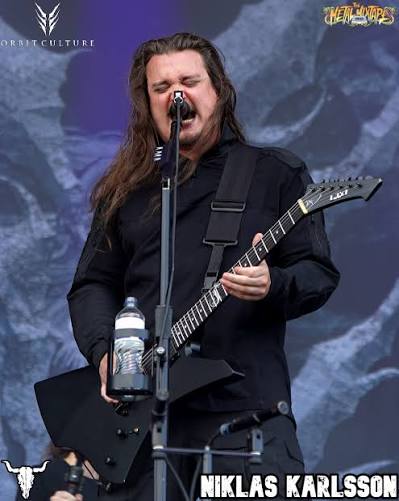
Niklas Karlsson and Richard Hansson wield matte-black ESP/LTD weapons—including the James Hetfield-inspired Snakebyte and LTD Arrow-1007 Baritone Evertune models—engineered to keep crushing drop tunings razor-tight under heavy right-hand picking.
Plugins Live & Cinematic Scope
Defying old-school tube-amp dogma, Orbit Culture famously runs Neural DSP digital rigs live for surgical, repeatable front-of-house clarity—allowing Niklas’s Hans Zimmer-inspired orchestral swells, pianos, and industrial sub-drops to hit like a freight train in every venue.
06 // The 3 AM Text: Madison Square Garden With Slipknot

Following the ferocious reception of their 2023 fourth album Descent and its companion EP The Forgotten, Orbit Culture found themselves in Pittsburgh in February 2024, tearing up stages on tour with Machine Head. An email landed from their booking agent: would they like to submit their name for an upcoming Slipknot arena tour? They laughed—Slipknot could pick from a thousand bands on earth—and said send it anyway. Then two months of total silence passed.
In April 2024, back home in Eksjö after a night of beers with the guys, Niklas stumbled awake at 3:00 AM to use the bathroom and glanced at his phone. Glowing on the screen was a text from their manager, Justin: "How does it feel to play Madison Square Garden with Slipknot?"
Speechless, Niklas woke his fiancée and immediately dialed his bandmates. For lifelong Slipknot diehards Richard and Chris, the news reportedly brought actual tears. When Orbit Culture stepped onto the floor of the World’s Most Famous Arena later that year, they became only the fourth Swedish act—and among the very first Swedish metal bands in history—to play Madison Square Garden. Back home in Eksjö, where the local ice hockey rink now proudly displays the Orbit Culture logo beneath the ice, nobody was asking if Niklas was going to quit anymore.
07 // Death Above Life, Burnout, and the Quiet Power of Sobriety

Century Media Records • Released October 3, 2025 • Deluxe Edition Released October 9, 2026
Signing with heavyweight metal institution Century Media Records set the stage for Orbit Culture’s defining statement: Death Above Life, unleashed on October 3, 2025. For the first time, Niklas—who had engineered and mixed almost everything himself since day one—handed mixing and mastering duties to fellow Swedish sonic colossus Buster Odeholm (Humanity’s Last Breath, Vildhjarta) at Odeholm Audio, while Niklas remained at the helm as songwriter, lyricist, engineer, and co-producer. Cloaked in Slovakian artist Miroslav Pecho’s nightmarish artwork, tracks like "The Tales of War," "Hydra," "Nerve," "Bloodhound," and the cavernous title track hauled Orbit Culture into an entirely new weight class. A year later, on October 9, 2026, Century Media issued the expanded Death Above Life (Deluxe Edition), adding "Nuclear God," "Spiral Head," "The Form Not Meant to Be," and a breathtaking reimagining of "The Path I Walk" featuring virtuoso cellist Tina Guo—complete with a subtle black-on-black packaging tribute to Metallica’s Black Album.
Yet behind the triumph of selling out their first headline runs across Europe and the United States, the human cost was catching up. For thirteen years, Niklas had woken up thinking about Orbit Culture and gone to sleep thinking about Orbit Culture. Even today, the band remains fiercely DIY—controlling their own crew, production, and economics from the ground up. After their April 2026 US headline tour, Niklas hit a wall of burnout. One man could no longer carry a global metal machine alone.
Instead of letting the engine blow, Niklas did something remarkably mature: he sat his bandmates down and divided the empire. Richard took over merch; Fredrik took over Eksjö HQ and office operations; Chris—the "muscles of the band"—took charge of touring logistics. Equally transformative was a personal decision Niklas made the year prior: after falling into the classic 24/7 tour-bus drinking trap during their late-twenties road debut, he quit drinking alcohol completely. Overnight, the hangovers vanished. His focus sharpened. He found a non-music obsession to reset his brain—watching staggering amounts of ice hockey—and suddenly, with clear mornings and a lighter administrative load, songs began pouring out of him again.
Essential Orbit Culture Discography
Odyssey, In Medias Res & Rasen
Forged in Eksjö's Spelverket power plant; "Sun of All" sparks underground buzz.
Redfog
"Saw" uploaded during Niklas's 24-hour social worker shift; lands Seek & Strike deal.
Nija & Shaman EP
First records with drummer Christopher Wallerstedt; establishes global fanbase.
Descent & The Forgotten EP
"From The Inside" and "Vultures of North" propel them to Machine Head & Slipknot tours.
Death Above Life & Deluxe Edition
Mixed/mastered by Buster Odeholm. Expanded Oct 9, 2026 with "Nuclear God" and Tina Guo guest feature on "The Path I Walk."
08 // The Fall 2026 Conquest: Trivium, In Flames, and What Comes Next
Even now, standing backstage one minute before showtime at European titans like Summer Breeze, Wacken, Bloodstock, and Leyendas del Rock, Niklas admits he still gets fiercely nervous—though the physical symptoms have evolved from wanting to vomit in his early days to just making endless trips to the bathroom. "It’s good to be a bit nervous," he says, "because then you’re activating your focus."
That focus has carried Orbit Culture through the most relentless autumn of their lives. After a triumphant hometown show in Eksjö at the end of August 2026, they spent the early fall serving as direct support across Europe for two of the very Swedish bands Niklas grew up worshiping: Amon Amarth and Soilwork. Barely pausing to breathe after the Madrid tour finale, they boarded a transatlantic flight straight into the heart of North America.
Right now—throughout November and December 2026—Orbit Culture are laying waste to North American theaters and ballrooms on Trivium’s "Crown in the Grave" World Tour, sharing an absurdly stacked bill with Gothenburg legends In Flames, Fit For An Autopsy, and Frozen Soul. Stretching from St. Petersburg, Florida on November 5 all the way to Charlotte, North Carolina on December 19—including a massive desert stop right in our own backyard at The Pearl in Las Vegas on December 3, 2026—this run feels less like a support slot and more like a coronation. Watching thousands of fists rise in unison to "From The Inside" and "The Tales of War" night after night, it is impossible to miss what is happening: the torch of modern heavy metal is being passed in real time.
And when the final chord rings out in Charlotte just before Christmas? Niklas plans to finally take a quiet, warm-weather vacation with his fiancée—and then head straight back into the studio in January 2027 to begin recording Orbit Culture’s sixth studio album, armed with a vault of devastating new riffs he has been writing since April. Not bad for a shy kid from Askeryd who refused to quit.
The Rockin' Roundtable Verdict
In an era of manufactured hype and overnight viral gimmicks, Niklas Karlsson and Orbit Culture are the real deal: thirteen years of rural grit, DIY stubbornness, and monstrous songwriting paying off at arena scale. If the Trivium, In Flames, and Orbit Culture juggernaut rolls anywhere near your city this November or December—especially Vegas on December 3—do not dare miss their set. You are watching metal’s next headliners claim their throne.